Writing · AI and technology leadership
Embracing the Fourth Industrial Revolution: a three-minute guide for organisations
For any company making physical products with digital capabilities, the Fourth Industrial Revolution has already arrived. The question is whether anyone can see the whole system.

I have spent most of my career building the products that the Fourth Industrial Revolution consists of. Not as a commentator on it, but as someone designing the systems where electronics, real-time firmware, cloud infrastructure, mobile applications, and increasingly AI meet in a single product. From embedded systems through IoT and connected platforms to connected vehicle systems, the shift described as 4IR is not an abstraction from where I sit. It is the engineering context I have worked in throughout my career.
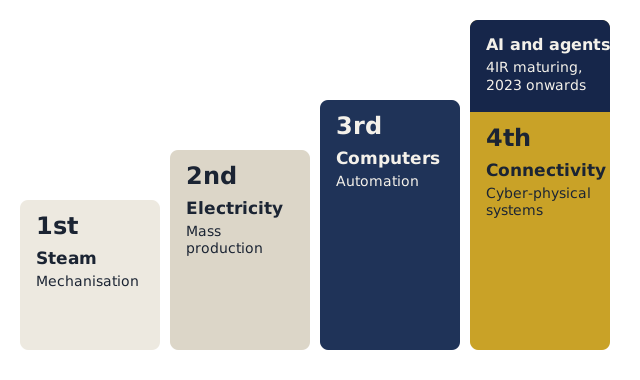
Which is perhaps why I find most of the organisational writing about it frustrating. The framing of "the Fourth Industrial Revolution is coming for your organisation" misses what is actually happening. For any company making physical products with digital capabilities, it has already arrived. The question is not whether to engage with it but how well your organisation understands what it actually requires.
What the convergence looks like from the inside
The defining characteristic of 4IR products is not any single technology. It is that the boundaries between disciplines have dissolved. A connected vehicle is simultaneously a mechanical product, an electronics product, a firmware product, a mobile product, and a cloud product. The motor control is safety-critical real-time firmware. The connectivity is BLE and cellular protocol engineering. The user experience is mobile software. The operational intelligence is cloud architecture. The regulatory compliance spans electrical, radio, road safety, and data protection frameworks.
Designing this kind of product requires holding all of those domains simultaneously. Getting any one of them wrong creates problems that are visible in the others. A firmware architecture decision constrains the cloud architecture. A mobile UX decision creates firmware requirements. A connectivity protocol choice has security implications that affect the cloud design. The disciplines are not parallel tracks. They are a single system.
What it requires of organisations
The leadership implication is direct. Organisations building 4IR products need technical leadership that understands the full stack, not leadership that treats hardware and software as separate departments reporting up to a non-technical executive. The invisible integration problems, the ones that produce field failures, schedule overruns, and security vulnerabilities, almost always live at the boundaries between disciplines. You cannot manage those boundaries from a position of not understanding what is on either side of them.
The second implication is that the product and the service are no longer separable. A connected product that ships a firmware update over the air, that generates data about its own usage, that can be remotely diagnosed or configured, is not a discrete physical product with a digital feature bolted on. It is an ongoing service delivered through a physical device. The business model, the support model, and the development model all follow from that. Organisations that still think of their hardware as the product and their connectivity as a feature are building on a conceptual model that does not match what they have actually built.
The practical question
The most useful question for an organisation navigating this is not "how do we adopt 4IR technologies" but "do we have people who can see the whole system." The technologies are available. The constraint is almost always the organisational capability to integrate them: to make architecture decisions that hold across disciplines, to catch the problems that arise at boundaries before they compound, and to build products that are coherent systems rather than collections of technically correct parts that do not quite work together.
That capability is what distinguishes the organisations that are leading in connected products from those that are struggling with them. It is not the specific technologies they use. It is whether their technical leadership can hold the whole picture at once.
Where AI fits
Generative and agentic AI have not changed this. They have raised the stakes. An AI agent that monitors a fleet, drafts a firmware change or acts on telemetry is one more discipline in the same system, and it fails at the same boundaries as the others. I see AI as the Fourth Industrial Revolution maturing, not a fifth one starting, and I set out why in Conscious AI: the same revolution, maturing. The practical question has not moved: does anyone in your organisation see the whole system, now that part of it can act on its own?
© 2024 Catherine Ives-Yim. All rights reserved.
Catherine Ives-Yim
Engineer, business leader and independent technical adviser, working on hard problems where technology and money meet. She has founded, grown and sold businesses, been chief operating officer and chief executive of listed technology companies, and led a rescue out of administration. Based in Leeds, working internationally.