Writing · AI and technology leadership
The AI nobody will admit to
At Machine Building Live the AI was in the products, but not in the conversation. Why, what that costs, and how to adopt it within the rules.

Somebody forgot to send the memo.
"AI" is so 2010s. The deep learning boom is more than a decade old, and the industrial conversation has moved on. It is now about edge AI: models running on the camera, the drive and the controller, right where the data is born. And about AI wired deep into the control loop itself, sensing and adjusting in milliseconds rather than reporting to a dashboard next week.
Nobody told Machine Building Live.
This morning I walked the floor at Stoneleigh. It is a good show: machine builders, system integrators and OEM engineers, meeting the companies that supply their drives, motion, sensors, safety systems, controls and cabinets. Some of the exhibitors are major players in building production systems. I went looking for machine learning and edge AI. I found computer vision attached to the usual robotic cells, and almost nothing else.
What struck me was not the silence. It was the bafflement. Ask about machine learning or edge AI and, on stand after stand, I got a polite, blank look. Some were UK distributors and integrators selling other people's kit, so perhaps I should not expect deep expertise. But with the odd exception, there was little sense of what these tools could do for their customers.
Where the knowledge did exist, it came out under the breath. Ask the right question in the right way and a quiet admission followed: yes, there is a trained model in that camera; yes, the engineers use AI tools. It was said as if it were slightly embarrassing.
So there are two problems. Many do not know, and those who do will not say. I want to look at both, at what they cost, and at how companies can adopt these tools safely and within the rules.
The AI is already on the stand
The vision systems I saw are the clearest example. Modern machine vision is mostly deep learning, running on the camera itself. Cognex, the market leader, is openly positioning itself as the leading provider of AI-powered machine vision. Its latest embedded systems run NVIDIA and Qualcomm processors, with training and inference on the device. That is edge AI by any definition. On a UK stand it is simply called "vision" or "inspection".
The wider machine-building industry is further on than the show floor suggests. IoT Analytics' 2026 study of machinery companies found more than half have scaled AI somewhere in their business. Quality control and defect detection are a priority for over 90% of them. Predictive maintenance is the most common production-floor use. Builders are starting to embed AI acceleration directly in machine controllers.
The same study ranks Europe behind Asia-Pacific and North America. And UK machine builders are mostly small firms, where the barriers bite hardest. So the gap I saw is partly real. But it is also a gap in what people are prepared to say, and that is the part worth examining.
Why they don't know, and why they won't say
The reasons are not mysterious. The first is a plain knowledge gap. The rest make silence the rational choice for each company, and a poor one for the sector.
1. Much of the channel does not understand the technology. Many UK stands are staffed by distributors and integrators whose expertise is drives, panels, safety and commissioning. Machine learning and edge AI sit outside that training. IoT Analytics found around four in ten machinery companies lack internal software talent. In 2024, Make UK found only 16% of manufacturers felt knowledgeable about AI's potential uses. You cannot sell, or even explain, what you do not understand. And where one person on the stand does understand, leading with AI invites questions the rest of the team cannot answer.
2. Safety culture distrusts anything it cannot fully explain. Machine builders sign off on guarding, interlocks and safety functions. Their professional instinct is determinism: the same input always gives the same output. "AI" suggests the opposite. Say it on a safety-led stand and the next question is "how do you validate it?" Many suppliers would rather not be asked.
3. Liability is getting sharper. The new EU Product Liability Directive covers products placed on the EU market from 9 December 2026. It treats software, including AI, as a product, with strict liability. If a supplier fails to disclose evidence when a claim is plausible, a court can presume the product was defective. Every public claim about AI is something a claimant's lawyer could later ask you to prove.
4. The customer is sceptical, and has reason to be. Production engineers have sat through Industry 4.0, digital twins and the IIoT, and many saw little return. "AI" now sounds like another pilot that never reaches the line. It is easier to sell "inspection" than to sell a technology the buyer has learned to distrust.
5. Admitting it can threaten the business model. Integrators sell engineering hours. If AI tools write PLC code, documentation and test scripts faster, the customer will expect a lower price. There is also the question of customer IP: pasting a client's code into a public AI tool may breach the NDA. Neither is something you want to raise at a trade show.
6. Individuals are hiding it too. A Deloitte survey of 25,000 UK workers, published in September, found almost one in ten had used an AI tool their employer banned or would disapprove of. 63% worried their manager might think AI could do their job. Half of AI users had no formal guidance. The survey lead described a "stigma" around AI at work. The under-the-breath admissions I heard look like that stigma at company level.
Regulation: real constraint or convenient cover?
Regulation is a real constraint, but only on a narrow slice of AI. It is being used as cover for silence about everything else.
| Rule | When | What it catches | What it leaves alone |
|---|---|---|---|
| EU Machinery Regulation 2023/1230 | 20 January 2027, no transition; Northern Ireland from October 2026 | Safety components and systems with self-evolving behaviour that ensure safety functions: notified body assessment, no self-certification | AI that does not perform a safety function |
| GB machinery rules | Update to the 2008 regulations planned, no date; CE marking still recognised | Expected to mirror the EU approach, including AI safety functions | As above |
| EU AI Act after the Digital Omnibus | Amendments in force 27 July 2026 | Machinery AI is taken out of the AI Act's direct high-risk rules; the Commission may add AI requirements through the Machinery Regulation later | AI used only for quality, efficiency or convenience is not high-risk just because it sits in a machine |
| EU Product Liability Directive | Products placed on the EU market from 9 December 2026 | All software and AI, under strict liability, with disclosure duties | Nothing: it applies to everything you sell |
Read that table from a machine builder's point of view. AI in a safety function needs a notified body. That is a genuine cost and a fair reason for caution. But quality inspection, predictive maintenance, energy optimisation and engineering productivity tools are not in that box. The EU has just gone out of its way to say so.
There is real uncertainty too. The Commission can still add AI-specific requirements to machinery through delegated acts, and GB has no date for its own rules. Waiting to see is understandable. Saying nothing is not the same thing, and it carries its own risk. The liability rules reward suppliers who can show how their AI was built, tested and monitored. Firms that hide their AI use are not building that evidence.
What the silence costs
Hidden AI cannot be shared, governed or improved, and the cost lands on all three links in the chain.
| Innovation | Productivity | Quality | |
|---|---|---|---|
| Component suppliers | Edge AI features ship but are never explained, so customers never design around them | Sales effort goes on features buyers already understand, not on new value | Models in cameras and drives are tuned once, without customer feedback to improve them |
| Machine builders and integrators | No shared practice: each engineer works out AI tools alone, off the books | Gains from AI-assisted engineering are hidden, so they are never standardised across the team | AI-generated code and documents are not reviewed as AI output, which is where errors slip through |
| Manufacturers | Buyers never ask for AI capability because nobody offers it, so specifications stay a decade old | Pilots stall without a supplier willing to own the result | Defect detection and predictive maintenance, the most proven uses, are adopted late or not at all |
The national picture shows where this ends up. The government's AI Champion for Advanced Manufacturing reported in June that UK adoption is "uneven and slow", with many firms, especially SMEs, stuck in a "pilot trap". In 2024, Make UK found 71% of large manufacturers using AI against 28% of SMEs. The UK already ranks 24th in the world for robot density.
A supply chain that will not talk about AI cannot pull its customers out of that trap. The prize is not small. Siemens UK, responding to the Catapult report, cited an OECD estimate that AI could add 0.4 to 1.3 percentage points to UK productivity growth over ten years. Silence on the show floor is one small reason we are unlikely to collect it.
Adopting it safely, within the rules
Safe adoption starts with one question: does the AI perform or affect a safety function? The answer sets the route, and for most uses the route is lighter than people fear.
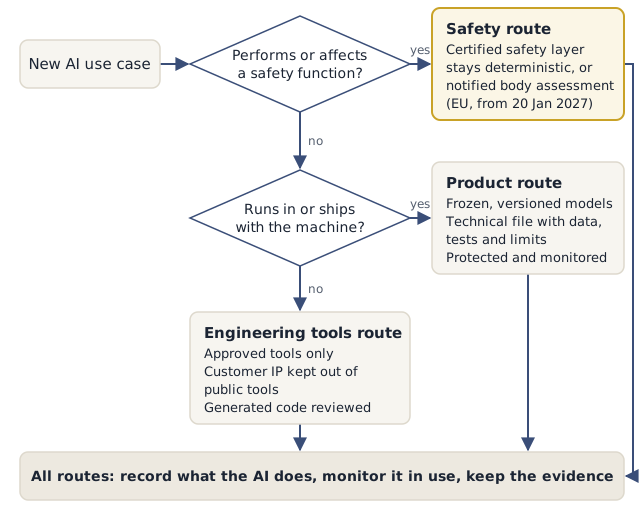
Most of the value, in quality inspection, predictive maintenance, energy optimisation and engineering productivity, sits on the two lighter routes.
On the safety route, the cleanest answer is architectural. Keep the certified safety layer (safety PLC, rated sensors and interlocks, designed to ISO 13849 or IEC 62061) deterministic, and let the AI advise or optimise above it. The AI can slow a line or flag a risk, but it cannot override the safety function. Where AI must itself ensure a safety function, plan for notified body assessment, and keep any learning within defined limits, as the Machinery Regulation requires.
On the product route, treat the model like firmware:
- Freeze and version models at release, with no unsupervised learning in the field.
- Put the model, the provenance of its training data, its test results and its operating limits in the technical file.
- Put model updates through change control, and check whether each one alters safety-relevant behaviour.
- Protect models and data against tampering. The new machinery rules add cybersecurity requirements, and IEC 62443 is the obvious reference.
- Monitor performance in service, and keep a human in the loop for rejects and overrides.
On the engineering tools route:
- Use approved enterprise tools on agreed terms, and keep customer code and drawings out of public tools.
- Review and test AI-generated PLC code, documentation and test scripts as if a junior engineer wrote them.
- Record what was AI-assisted, so you can answer when a customer, or a court, asks.
Edge AI helps on every route. Running the model on the machine keeps production data and customer IP on site, gives predictable latency and works without a cloud connection. For firms that want a management framework around all of this, ISO/IEC 42001 provides one.
None of this is exotic. It is the discipline machine builders already apply to safety and firmware, extended to models. The firms that build it now will be able to talk about their AI with confidence when the rules settle.
Five things worth taking seriously
The answer is not more AI hype. Our industry has had enough of that. The answer is honesty about what is already in use, and discipline about how it is used.
For component suppliers: explain the AI that is already in your products. A camera that runs a trained model is a selling point, not a liability, provided you can say how it was trained, tested and kept within limits.
For machine builders and integrators: keep AI out of safety functions until you are ready for a notified body, and talk openly about it everywhere else. Bring your engineers' AI tools into the open, with approved tools, guidance on customer IP and a review step for generated code.
For integrators pricing work: sell the outcome rather than the hours. That is the only way to pass on the productivity of AI-assisted engineering without giving away the margin.
For manufacturers: ask your suppliers what AI is in the equipment you are buying, and how it is validated. A supplier who cannot answer is telling you something.
For everyone: write it down. A record of which models you use, what data trained them, how they were tested and how they are monitored is your liability defence and your sales story at the same time.
I have watched enough technology waves to know the pattern. The firms that win are rarely the ones shouting loudest. They are the ones who understand what the technology actually does, use it where it earns its place, and are not embarrassed to say so. At Machine Building Live, the technology was there. The confidence was not.
I would be interested to hear whether your suppliers have ever explained the AI in the equipment you bought from them, or whether, like most of the stands I visited today, they would rather you did not ask.
Sources
- Machine Building Live 2026 listing
- Cognex Q1 2026 earnings call highlights
- IoT Analytics: AI Adoption in Machine Building 2026
- Deloitte survey: UK workers hide AI use from their bosses
- Kennedys: the new EU Product Liability Directive
- Machinery Regulation timeline
- Gowling WLG: UK machinery legislation, the government's response
- Lewis Silkin: Digital Omnibus on AI enters into force
- The Manufacturer: AI adoption stalls at pilot stage
- Machinery: Make UK and Autodesk, Future Factories powered by AI
© 2026 Catherine Ives-Yim. All rights reserved.
Catherine Ives-Yim
Engineer, business leader and independent technical adviser, working on hard problems where technology and money meet. She has founded, grown and sold businesses, been chief operating officer and chief executive of listed technology companies, and led a rescue out of administration. Based in Leeds, working internationally.